Dennistoun Rail Report: Nationalisation, Penalty Fares, and App Chaos
For the residents of Dennistoun, rail travel is more than just a convenience, it is an essential lifeline. Whether commuting from Alexandra Parade, boarding at Duke Street, or catching a train at Bellgrove, thousands of east end residents rely on ScotRail daily to connect them to Glasgow city centre and beyond. However, a series of sweeping policy changes, technical failures, and systemic delays have left local commuters asking: is Scotland’s nationalised railway actually delivering for our community?
1. The Nationalisation Promise vs. Reality
On April 1, 2022, former First Minister Nicola Sturgeon stood at Glasgow Queen Street Station and hailed the nationalisation of ScotRail as a "historic and momentous occasion" [2]. Under direct Scottish Government control, the railway was promised to be "affordable, sustainable and customer-focused," stripping private operator Abellio of its franchise early due to poor performance and cancellations [1], [2].
Four years later, local commuters are feeling a very different reality. Rather than improving, the service has become significantly more expensive for taxpayers while performance has declined:
- Costs Have Doubled: New financial disclosures reveal that the annual cost to the taxpayer of running ScotRail has skyrocketed, hitting a record £818.572 million in the 2024/25 period alone [3]. Under nationalisation, public subsidies have doubled compared to the pre-pandemic years under Abellio, putting immense pressure on the public purse [3].
- Declining Services: Despite the record funding, the daily train schedule agreed with Network Rail has dropped by 14%, slumping from 796,483 planned services under Abellio to just 683,372 in 2024/25 [3]. Passenger journeys have also crashed from 96.4 million to 84.7 million [3].
- Worse Punctuality and Surge in Cancellations: Punctuality has slipped below the levels of the much-criticised Abellio era. In 2024/25, only 89.72% of trains arrived on time (within five minutes of schedule), failing to meet even the downgraded target of 90.7% [3]. This is worse than Abellio's 90.4% record in 2018 when they were under a government performance notice [3]. Furthermore, almost 17,500 services were cancelled in the 2024/25 period, severely undermining the network's reliability [3].
2. The Penalty Crackdown: The £10 Minimum Fare
To make matters more challenging for passengers, ScotRail launched a strict new anti-fare evasion policy on July 1, 2026 [4]. Following an "education campaign" that began on April 1, anyone caught boarding a train without a pre-purchased ticket from a station where ticket-buying facilities are available is now hit with a £10 minimum penalty fare [4], [5].
While ScotRail argues that ticketless travel costs the railway over £11 million annually [5], the policy disproportionately penalises honest local passengers making short trips:
- A Massive Penalty for Local Journeys: For short trips in and around Glasgow, the £10 minimum fare acts as a massive surcharge. For example, a return ticket between Bishopbriggs and Glasgow Queen Street is normally £3 [4], [5]. If a passenger boards without a ticket, they pay a £7 premium [4].
- The Bellgrove Digital Ban: This crackdown is particularly frustrating for Bellgrove passengers. In January 2025, ScotRail scrapped digital tickets at Bellgrove Station to combat "origin fraud" (people claiming they boarded at Bellgrove to pay a cheaper fare when they had actually boarded earlier) [7]. As a result, honest local commuters are forced to print paper tickets at self-service machines on the platform before boarding, leading to queues, missed trains, and environmental concerns [7].
"Having had to switch to Bellgrove myself after Alexandra Parade's closure, I'm at a loss why ScotRail have stopped digital tickets for Bellgrove to Queen St. Why force folk to print tickets needlessly at the waste of paper and ink when our digital option worked just fine? I'd urge ScotRail to re-instate the digital ticket option as soon as possible." - Anthony Carroll, Scottish Greens Councillor for Dennistoun [7]
3. Modernizing Bellgrove: A Major Accessibility Overhaul
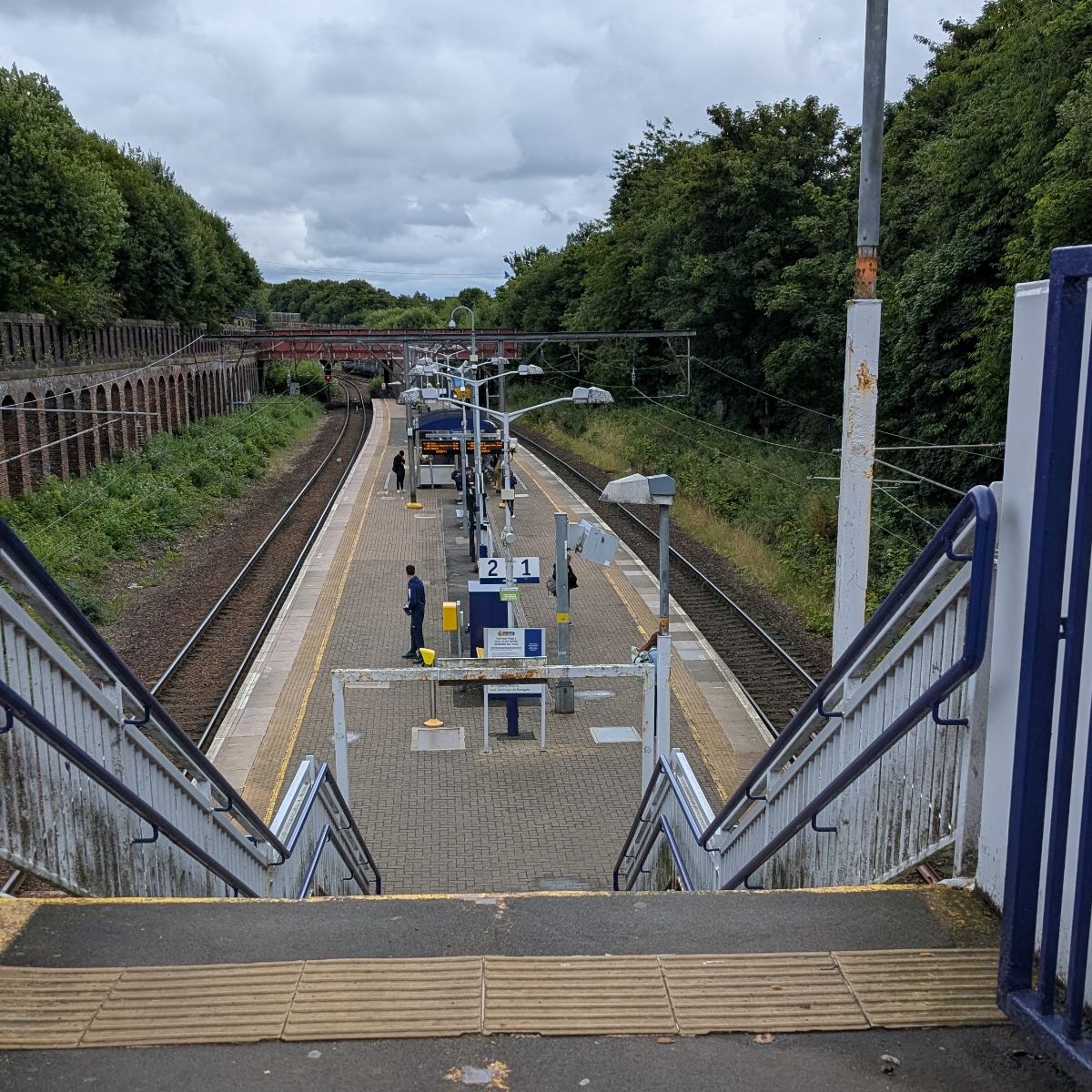
While Bellgrove commuters have struggled with digital restrictions, the physical infrastructure of the station is finally set for a long-overdue transformation. First opened in 1871, the station is Glasgow’s 12th busiest, serving approximately 750,000 passengers every year [6]. It is a vital rail artery, carrying passengers on busy routes from Edinburgh Waverley, Bathgate, Airdrie, Helensburgh, Queen Street Low Level, Milngavie, and Balloch [6].
Despite its massive traffic, including hundreds of thousands of football fans visiting nearby Celtic Park, music fans heading to Glasgow Green and the TRNSMT festival, and locals accessing the vibrant neighborhoods of Dennistoun and Calton, the station has not seen a major access upgrade in over 150 years [6]. Passengers must currently navigate a single, narrow, and exceptionally "steep" staircase from Bellgrove Street down to the island platform, completely excluding wheelchair users and parents with prams [6].
However, new UK Government funding has now been secured to completely redevelop the station [6]. This major project will see lifts/elevators installed alongside a modern staircase for the first time in over a century, resolving the long-standing accessibility issues and supporting the ongoing regeneration of the old Glasgow Cattle and Meat Market across the road [6].
"Bellgrove is seeing a revival... The station's access has remained restricted to a single staircase since 1871, but these upgrades are crucial as the area undergoes massive regeneration." - Paul Sweeney, Glasgow MSP [6]
"These upgrades are very important for my constituents – improving accessibility at the station and allowing more people to travel by train in the area." - John Grady, Glasgow East MP [6]
Local Angle: Commuters are hopeful that this multi-million-pound physical upgrade will be matched by a modern, fair approach to digital ticketing, rather than continuing the frustrating digital "ticket ban" currently in place [6], [7].
4. The New ScotRail App: A "Total Shambles"
To make matters worse, ScotRail chose to introduce a completely new mobile app and website booking platform on Thursday, July 30, 2026, replacing the old platform supplied by Trainline [8], [9]. Instead of a seamless upgrade, the launch erupted into widespread chaos as over 220,000 users attempted to download the new app on day one [10]. This digital failure directly collided with the strict pre-purchase rules of the new £10 minimum fare policy [4], [9].
- Widespread Technical Glitches: Commuters reported that they were unable to reset passwords, could not link their Senior Railcards, and had their saved payment details entirely wiped [9]. Others found that their home stations (such as Wick) were missing from the app's station lists entirely, or that train search results failed to display altogether [9].
- The Ticket Trap: Early on launch morning, ScotRail told passengers they could continue using the old app to buy tickets until midday [9]. However, the old app was blocked with prompts to download the new version, forcing ScotRail to scrap the deadline as problems continued [9]. If a passenger could not buy a ticket via the faulty app, and faced long queues at Bellgrove's ticket machines, they were left with a terrible choice: miss their train, or board without a ticket and risk being slapped with a £10 penalty fare [4], [7], [9].
- Ongoing Issues: Commercial Director Claire Dickie apologised for the "genuine technical problems," claiming most were resolved [10]. However, weeks later, STV News reported that passengers are still facing persistent bugs, including return tickets defaulting to double-priced singles [10].
- Update: 01/09/2026: Passengers experiencing that their return ticket showed expired before it was used. Being logged out and unable to log back in to use the return part of their ticket. Having to remember to select their railcard each time they open the app.
5. The Delay & Repay Backlog
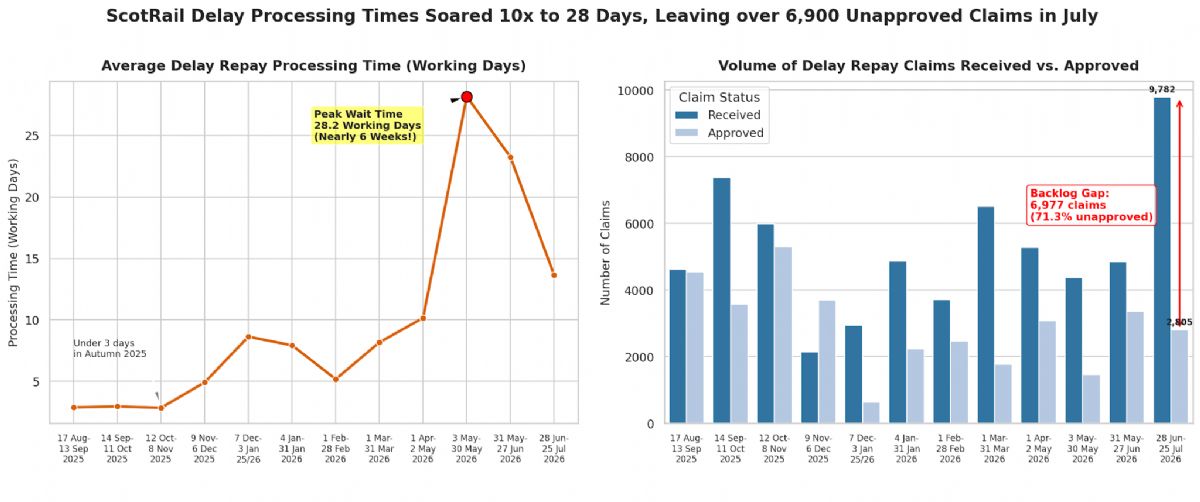
When services fail, passengers are advised to claim compensation under the Delay & Repay scheme. When delayed 30 to 59 minutes you will receive 50% of the cost of your single ticket or 25% of the cost of your return ticket. When delayed 1 hour to 1 hour 59 minutes you receive the full cost of your single ticket or 50% of the cost of your return ticket and when delayed for 2 hours or more you receive the cost of your single or return ticket. However, an analysis of ScotRail's internal data from a Freedom of Information (FOI) request reveals that the compensation system itself is severely backlogged under the weight of delayed passengers.
- High Rejection and Backlog Rates: In the four-week period from June 28 to July 25, 2026, ScotRail received a massive 9,782 Delay Repay claims, but approved only 2,805, meaning nearly 71.3% of claims remained outstanding, delayed, or rejected in the backlog.
- Waiting a Month for Payouts: Commuters delayed during the spring and summer have faced extraordinary waits. The average claim processing time skyrocketed to 28.16 working days in May 2026 and 23.24 working days in June 2026.
6. Local Voice: "I'll Be Taking the Citylink Bus Next Time"
To see how these systemic failures impact local residents a Dennistoun pensioner tells of his experience of a recent rail journey that turned into a travel nightmare. On July 17, 2026, the pensioner boarded the Inverness to Glasgow (Queen Street) service at Aviemore to return home. The train, full to capacity with only three carriages, suffered a severe engine failure.
"The train stopped and stuttered along the track as the driver and conductor checked the engines and doors," he recalled. "It crawled all the way to Perth, where the service terminated early, leaving us stranded."
After being delayed for over an hour, train staff advised the pensioner to claim compensation via the Delay & Repay system. It was 28 days later before he received payment. The pensioner’s experience also highlighted a major flaw in ScotRail’s digital claim process:
"As usual, you don't know how bad a service is till you are involved in it. I'll be taking the Citylink bus the next time even if it takes longer. It will be more comfortable and reliable, and it's free with a bus pass. I claimed for Delay & Repay on the 17th July and I received compensation 28 days later. My split ticket from Queen Street to Alexandra Parade was not covered as I could only upload 1 ticket on their online form."
Because the online Delay & Repay form only permitted a single ticket upload, the pensioner's connecting journey from Glasgow Queen Street to Alexandra Parade was completely excluded from their claim.
Summary: A System in Need of Track Repairs
Between the high taxpayer subsidy, falling punctuality, the £10 penalty fare trap, a broken app, and backlogged compensation claims, Dennistoun commuters are paying more to receive far less [3], [4], [11]. While the physical accessibility upgrades at Bellgrove Station represent a major step forward for the East End, ScotRail must urgently fix its basic software and customer service failures if it wants locals to keep choosing the train over the bus [6], [7].